
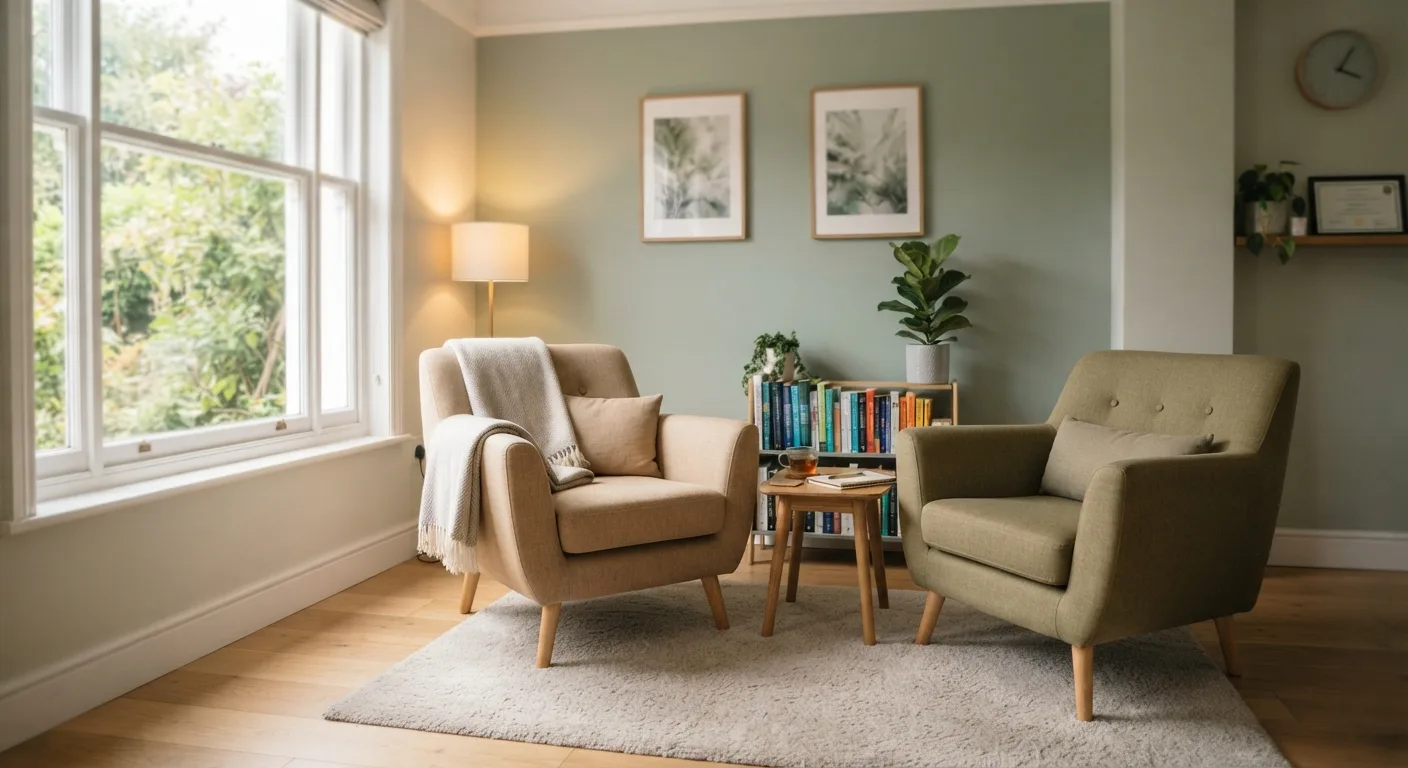
Many people turn to psychotherapy when something has become too heavy to carry: anxiety that will not settle, a tiredness that never lifts, relationships that keep stalling in the same place. Yet psychotherapy is not only a way to "fix" something. It is also a way to know yourself and to live your life more freely. In this article we look at what psychotherapy is, how it works and what it can change in a person's life, drawing on what research has found.
What is psychotherapy?
Psychotherapy is a form of treatment in which emotional, relational and psychological difficulties are explored through conversation, within a safe relationship with a trained therapist. The aim is not only to relieve symptoms, but to understand the inner conflicts, repeating patterns and life experiences that keep those symptoms alive.
Psychotherapy is not advice-giving. Nor is it life coaching or the teaching of a single mental technique. The therapist opens a space in which you can find your own answers; the real subject of the process is you.
How does psychotherapy work?
There are many schools of psychotherapy: Jungian analytical psychotherapy, psychoanalytic and psychodynamic therapies, cognitive behavioural therapy, supportive psychotherapy, and couples and group therapy. Their methods differ, but they share one foundation: the relationship between therapist and client.
Researchers call this relationship the therapeutic alliance. A meta-analysis of 295 studies covering more than 30,000 patients found that the strength of the alliance is one of the most consistent predictors of how well therapy works (Flückiger et al., 2018). Put simply, a relationship in which you feel understood and safe is the very setting that makes change possible.
A typical process looks like this:
- First session: we talk about what brings you to therapy, your life story and your expectations.
- Assessment and plan: a psychiatric assessment is carried out if needed, and the approach and frequency of sessions are agreed together.
- Regular sessions: usually once a week, for 45–50 minutes, working with your inner world, relationships, past and dreams.
- Ending: when the goals have been reached, therapy is brought to a close together and with preparation.
What does psychotherapy change in our lives?
1. Symptoms ease and everyday life comes back
Symptoms such as depression, anxiety, panic attacks, obsessions or sleeplessness narrow a person's work, relationships and daily life. In 2012 the American Psychological Association (APA) adopted a resolution recognising that the effects of psychotherapy are significant and large, and that they are fairly consistent across most diagnoses. As symptoms ease, people can return to the areas of life they had been avoiding.
2. Gains last, and can even continue after therapy ends
One of the most striking features of psychotherapy is that its effects do not stop when the sessions do. The same APA resolution notes that the results of psychotherapy tend to last longer, and are less likely to require further treatment, than those of medication alone. In depression, a meta-analysis found that patients treated with therapy were markedly less likely to relapse than patients whose medication had been stopped (Cuijpers et al., 2013).
In depth-oriented therapies this trend may be even stronger. According to Shedler's (2010) review, patients who receive psychodynamic therapy not only keep their gains but continue to improve after treatment ends; at follow-ups of nine months or more, the effect size grew by around 50 per cent. One explanation is that what you learn in therapy is not a piece of information, but a new way of relating to yourself, and that relationship keeps growing on its own.
3. You come to know and accept yourself
In therapy, people meet the parts of themselves they would rather not see. Jung called these parts the shadow: anger, envy, need or vulnerability, the sides of ourselves we find hard to accept. Meeting the shadow frees the energy that was spent keeping it down. People learn to be less harsh with themselves, more realistic and more compassionate.
4. Relationships change
Do you keep being drawn to the same kind of person, or having the same arguments? Psychotherapy makes the relationship patterns we carry from the past visible. The relationship with the therapist itself becomes a safe place where these patterns can be lived and understood. Over time, people learn to set boundaries, to voice their needs and to experience closeness with less fear. Couples therapy brings this work into the cycle between two people.
5. Your capacity to bear feelings grows
Therapy opens a third way between suppressing feelings and drowning in them: noticing them, naming them and being able to hold them. This capacity makes us more resilient in the face of life's unavoidable difficulties.
6. Loss and trauma find a meaning
Losses and traumas can leave unresolved knots in our inner world. The work of mourning, which Freud described with the concept of Trauerarbeit, is the gradual going-over of the feelings and memories bound to what has been lost. Therapy accompanies this work; the aim is not to erase the pain, but to make it bearable and meaningful.
7. The brain changes too
The effects of psychotherapy are not confined to "the mind". A systematic review of brain-imaging studies found that psychotherapy produces measurable changes in brain function. Depending on the condition, these appear either as a normalisation of altered activity patterns or as the recruitment of additional brain areas (Barsaglini et al., 2014). A treatment made of words can change the way the brain works.
8. Life gains meaning: individuation
Jung held that throughout life we move towards our own wholeness, a process he called individuation. In analytical psychotherapy, symptoms are not seen only as problems to remove; they are also read as messages through which the psyche asks for attention. A midlife crisis, a search for meaning or the feeling of "not really living my life" is often the herald of such a call. Working with dreams is one of the richest ways to hear it.
Who is psychotherapy for?
You do not need to be "in a very bad way" to benefit from psychotherapy. If any of the following feels familiar, an initial consultation can be a good start:
- Unhappiness, anxiety or restlessness that has lasted for weeks
- Recurring problems in relationships, or a sense of loneliness
- Difficult transitions such as a loss, a separation, a move or a change of job, including relocating to a new country
- Past traumatic experiences that still affect your life
- A wish to know yourself better and to give your life more meaning
If you have thoughts of harming yourself or someone else, please do not wait: call 112 (or your local emergency number) or go to the nearest emergency department.
Are psychotherapy and medication alternatives to each other?
No; more often they complement each other. For many mild to moderate problems, psychotherapy alone can be effective. In conditions such as severe depression, bipolar disorder or psychotic disorders, medication is essential, while psychotherapy deepens recovery and reduces the risk of relapse. Working with a therapist who is also a psychiatrist means both paths can be considered within one coherent view.
Psychotherapy in English at Antalya Ruhbilim Okulu
Dr. Murat Kemaloğlu trained in analytical psychotherapy at the C.G. Jung Institute in Zurich and has worked at Antalya Ruhbilim Okulu since 1989. He offers individual Jungian analytical psychotherapy and couples therapy in English and Turkish, in person in Antalya or online wherever you live. This can be especially helpful for expatriates and international residents who want to work through personal matters in English. To learn more, visit our Psychotherapy page or get in touch.
Frequently asked questions
How long does psychotherapy take? It varies from person to person. Work focused on a specific problem may take a few months; working with deep-rooted patterns and aiming for lasting change takes longer. The length is planned together in the first sessions.
Can psychotherapy be done online? Yes. For many problem areas, online psychotherapy has been found to work nearly as well as face-to-face sessions. All you need is a secure video connection and a quiet room.
Is what I say in therapy confidential? Yes. Everything shared in sessions is protected by medical ethics and the principles of confidentiality, and is not shared with third parties except where required by law.
What is the difference between psychotherapy and talking to a friend? Talking to a friend can bring relief, but it often stays in the same place. In psychotherapy, the therapist's training and experience allow them to notice the patterns, feelings and unconscious meanings beneath what is said, and the relationship is a space deliberately set up for that work.
Do I need to prepare for the first session? No. You do not even need to know exactly why you have come. The purpose of the first session is to begin to understand that together.
References
- American Psychological Association (2012). Recognition of Psychotherapy Effectiveness. APA Council of Representatives.
- Flückiger, C., Del Re, A. C., Wampold, B. E. ve Horvath, A. O. (2018). The alliance in adult psychotherapy: A meta-analytic synthesis. Psychotherapy, 55(4), 316–340.
- Shedler, J. (2010). The efficacy of psychodynamic psychotherapy. American Psychologist, 65(2), 98–109.
- Cuijpers, P., Hollon, S. D., van Straten, A., Bockting, C., Berking, M. ve Andersson, G. (2013). Does cognitive behaviour therapy have an enduring effect that is superior to keeping patients on continuation pharmacotherapy? A meta-analysis. BMJ Open, 3(4).
- Barsaglini, A., Sartori, G., Benetti, S., Pettersson-Yeo, W. ve Mechelli, A. (2014). The effects of psychotherapy on brain function: A systematic and critical review. Progress in Neurobiology, 114, 1–14.
The content on this site is for general information only and does not replace diagnosis or treatment. In an emergency, call 112.